Choosing Fabric for Sportswear, Streetwear & Casual Apparel: How Fabric, GSM & Decoration Methods Work Together
Most fabric guides teach definitions. This one exists to make fabric selection for custom apparel a decision, not a guess — by the end, you should be able to tell a manufacturer exactly what to build, without needing to check another source first.
Experienced manufacturers don’t choose fabric by starting with GSM, even though that’s the number most buyers fixate on first. They work through five factors in order — product type, decoration method, fabric composition, knit construction, and only then GSM — because each decision narrows the next. Skip the order, and you end up with a fabric that looks right on a spec sheet but can’t actually do the job.
- 1The five-factor order manufacturers use, and why the sequence matters
- 2Why decoration method gets decided before fabric, not after
- 3Why knit construction changes performance more than GSM, even at identical weight
- 4What sportswear, streetwear, and casual apparel each need from a fabric
- 5Why a blank swatch can’t predict how a finished garment will actually behave
Key Takeaway: Fabric selection is five decisions made in order, not one decision made from a weight chart. Buyers who start with GSM are starting at the wrong end.
How Manufacturers Approach Fabric Selection for Custom Apparel
Manufacturers evaluate product type, decoration method, fabric composition, knit construction, and GSM in that order — each step eliminates options for the next, which is why working out of order usually produces a worse result.
The product type tells you its job. The decoration method rules out entire fiber categories immediately (sublimation, for instance, only works on polyester). Composition narrows further from what’s left. Construction determines how that composition actually drapes and performs. GSM comes last, because weight only means something once you know what you’re weighing and why..
The framework doesn’t end at GSM — it ends at bulk production, with sample approval as the checkpoint between them. A fabric spec that hasn’t been tested on a decorated sample is still a prediction, not a confirmed decision.
Key Takeaway: Each step narrows the next. Skipping straight from a product idea to a GSM number skips four decisions that should have shaped it.
The Product
Sportswear needs moisture management and stretch recovery above almost everything else — a fabric that feels premium but doesn’t wick sweat or hold shape isn’t doing its job.
Streetwear needs hand-feel, drape, and decoration compatibility with screen print and embroidery — the technical metrics that matter for sportswear are largely beside the point here.
Casual apparel, including blank t-shirts, needs cost efficiency and decoration versatility, since these garments typically serve many different end uses rather than one job.
Uniforms — team kits — sit closer to sportswear’s priorities but add a consistency requirement across an entire roster order.
Key Takeaway: “Best fabric” is an incomplete question until the product is specified. Sportswear and streetwear can have directly conflicting priorities.
The Decoration Method
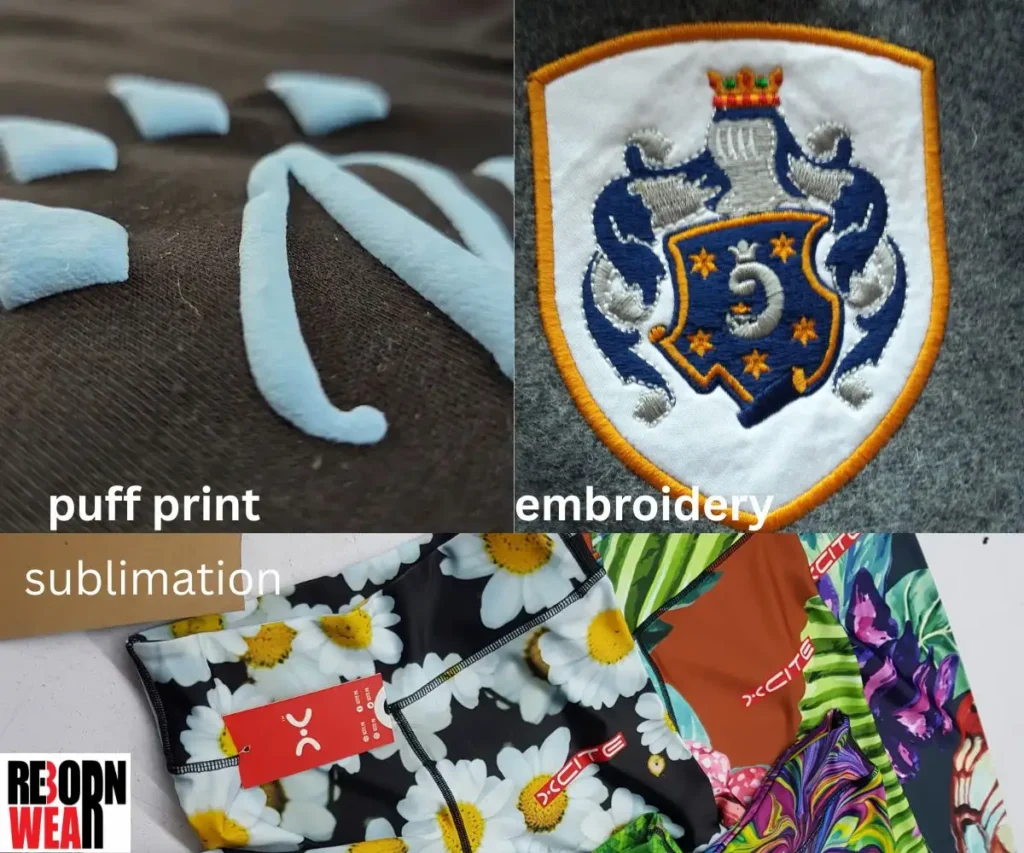
Decoration method gets decided before fabric composition because it eliminates entire fiber categories immediately — sublimation requires high polyester content to work at all. That’s chemistry, not preference.
Sublimation bonds dye into fiber through a heat-activated gas process that fundamentally requires polyester. Cotton won’t take it with real vibrancy. This is why team jerseys are almost always polyester.
Embroidery needs weight and structure to support stitch density without puckering — heavyweight fleece and structured cotton perform better here than lightweight jersey.
Screen printing is more fabric-flexible, but surface texture still matters — a smooth, tight knit holds fine detail better than a textured or brushed one.
DTF and heat transfer are the most fabric-agnostic, which is why they’re common for mixed-catalog private label work.
| Decoration | Fabric Requirement | Best Match |
|---|---|---|
| Sublimation | High polyester content | Polyester jersey, interlock |
| Embroidery | Enough weight/structure | Heavyweight fleece, structured cotton |
| Screen Printing | Smooth, tight-knit surface | Cotton, cotton-poly blends |
| DTF / Heat Transfer | Broadest compatibility | Cotton, polyester, blends |
Buyers often treat decoration method as the last creative decision and fabric as the first technical one. In practice it’s the reverse — a production team needs to know the decoration method before it can responsibly recommend a fabric.
The Composition
Cotton offers hand-feel and breathability but limited moisture-wicking and shape retention over time. Polyester offers moisture management and shape stability but a less natural feel. Cotton-poly blends split the difference — a common ratio is roughly 80/20, capturing most of cotton’s feel while gaining meaningful shape stability from the polyester content. Performance blends add a small percentage of spandex for stretch and recovery.
Composition also determines how color behaves over the garment’s life, not just during decoration. Polyester holds saturated, sublimated color through repeated washing better than cotton holds a printed color — part of why a jersey washed weekly still looks vivid at season’s end while a heavily-washed cotton print can visibly soften.
| Cotton | Polyester | Cotton-Poly Blend | |
|---|---|---|---|
| Hand-feel | Soft, natural | Slicker | Balanced |
| Moisture management | Absorbs | Wicks | Moderate |
| Shape retention | Weaker over time | Strong | Improved |
| Best decoration match | Screen print, DTG | Sublimation | Screen print, DTF |
Key Takeaway: Composition trades hand-feel against technical performance — there’s no universally “best” fiber, only the right ratio for what Steps 1 and 2 already determined.
Manufacturer Insight: Two manufacturers can look at the same brief and genuinely recommend different fabrics, and neither is necessarily wrong. The difference usually traces back to real structural factors — one manufacturer’s machinery leans toward polyester recommendations, another’s toward cotton, simply because that’s where their equipment produces the best result. A different recommendation isn’t automatically a red flag; it’s worth understanding a manufacturer’s specialization before treating any single answer as the only correct one.
The Knit Construction
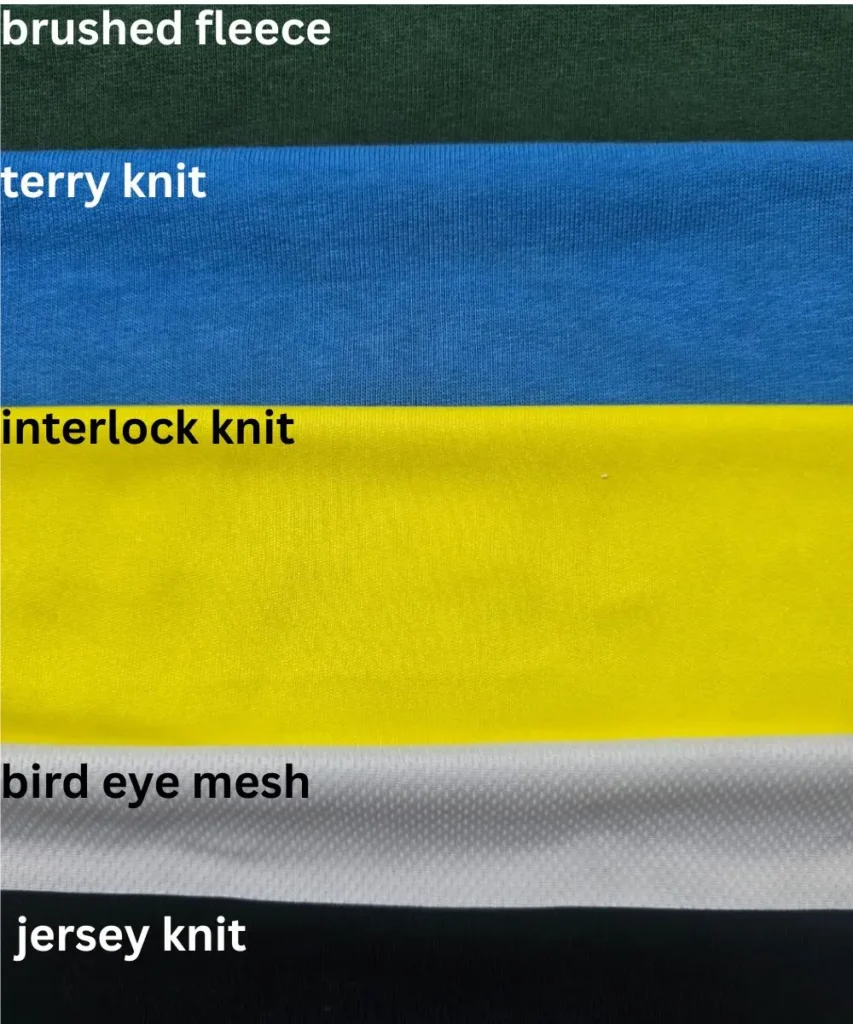
Knit construction — how yarn is actually looped and structured, not just what fiber it’s made from — often changes performance more than GSM does, which is why two fabrics at the same weight can feel and perform completely differently.
Single jersey is the lightest, most economical knit — the t-shirt default. It curls at cut edges and has the least stability here, so dense embroidery can distort it.
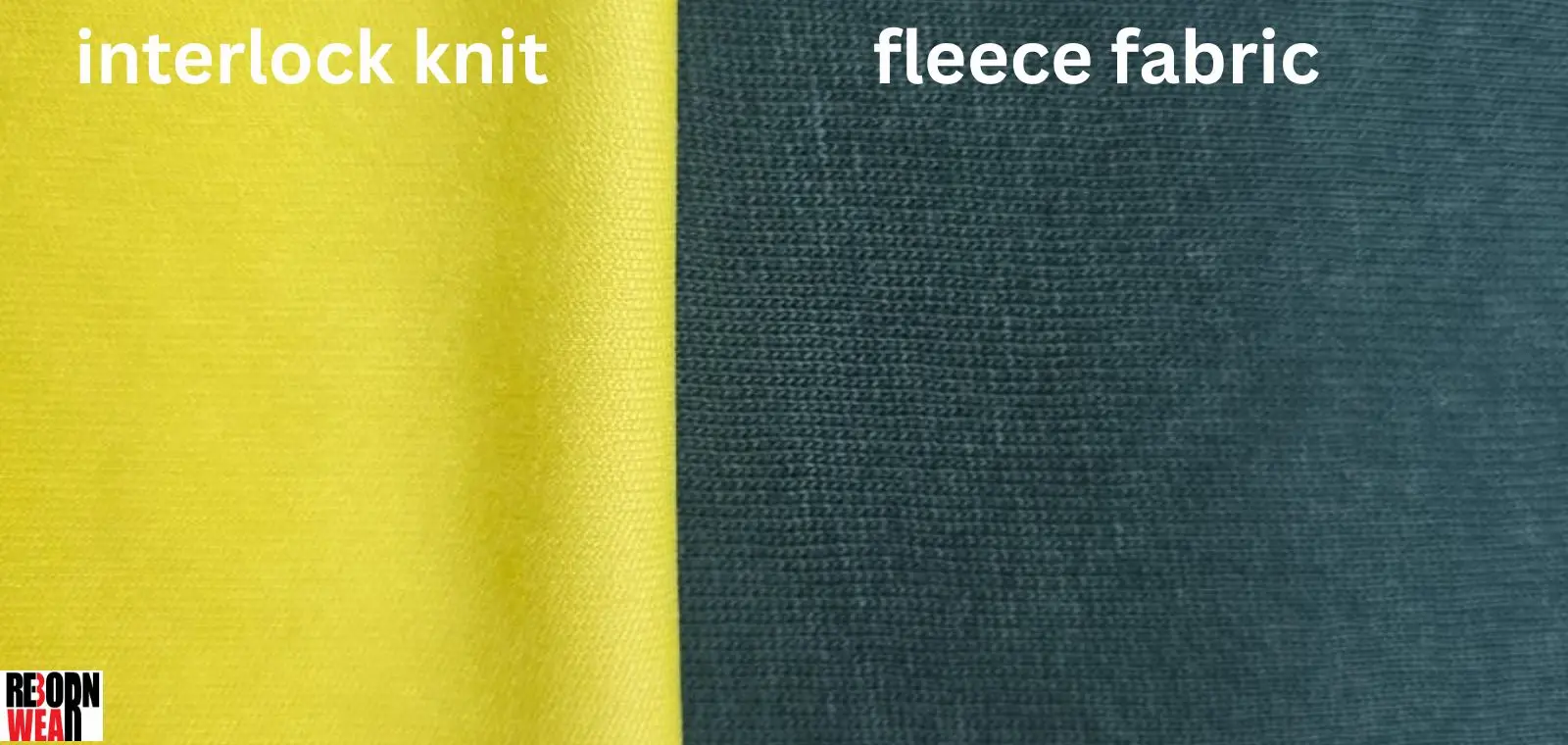
Interlock is a denser double-knit, common in performance jerseys because its stability holds shape under stretching and its smoother surface gives sublimation cleaner print clarity.
French terry is a smooth-faced, loop-back knit — lighter than fleece, suited to warmer-weather layers. Its looped interior traps less air than fleece’s brushed surface.
Brushed fleece takes a similar base structure but brushes the interior into a napped surface, trapping more air for warmth — and giving embroidery enough structure to avoid puckering, which is why it’s the common choice when embroidery is the decoration method.
Bird’s-eye mesh uses a perforated structure built almost entirely around airflow — common in performance sportswear, rarely seen elsewhere, since ventilation is its whole purpose.
Piqué is the textured, slightly raised knit associated with polo shirts, holding fabric slightly away from skin and changing how screen print settles onto the surface.
Rib knit stretches and recovers more reliably than the others, which is exactly why it’s used for collars and cuffs rather than full garment bodies — a full rib-knit garment would feel too form-fitting for most casual applications.
Manufacturer Insight: Construction is rarely specified as clearly as weight and fiber content, even though it often affects the finished product just as much — a buyer reordering by GSM and composition alone can get a noticeably different fabric back if construction wasn’t named explicitly. New buyers also frequently ask for the heaviest available GSM, assuming weight signals quality — in production, heavier mostly means more material and cost, and past a certain point can work against the product.
The GSM
GSM measures weight, and only weight — it comes last because a weight number only means something once product, decoration, composition, and construction are already decided.
Lighter options (120–180 GSM) suit performance sportswear. Mid-weight (160–220 GSM) covers most t-shirts and basics. Heavier options (280 GSM+) are where hoodies and premium streetwear typically land.
GSM still doesn’t guarantee quality. A heavy fabric with weak, open-end spun yarn — which leaves more loose fiber ends on the surface — pills faster than a lighter, well-constructed fabric using combed, ring-spun yarn. A manufacturer who can name the yarn type is answering the durability question directly instead of pointing at a weight label.
Fabric weight is measured against an actual standard, not eyeballed — ASTM D3776 defines how GSM is measured consistently across mills. Two suppliers quoting the same GSM should be measuring against the same standard — worth confirming when it matters.
| Weight | Typical Use |
|---|---|
| 120–180 GSM | Performance sportswear, lightweight layers |
| 160–220 GSM | T-shirts, casual basics |
| 220–280 GSM | Team uniforms, mid-weight layers |
| 280–400+ GSM | Hoodies, premium streetwear |
Key Takeaway: A 320 GSM spec means nothing on its own — 320 GSM cotton fleece and 320 GSM polyester interlock are built for completely different jobs. The number only becomes useful once the four steps before it are already answered.
Applying the Framework
| Garment | Priority | Common Decoration | Composition | Construction | GSM |
|---|---|---|---|---|---|
| Hoodie | Structure, premium feel | Embroidery, screen print | Cotton-poly | Brushed fleece | 280–400+ |
| T-shirt | Comfort, versatility | Screen print, DTF | Cotton-poly | Single jersey | 160–220 |
| Joggers | Stretch, movement | Screen print, embroidery | Performance blend | Terry or fleece | 240–320 |
| Blank t-shirt | Cost efficiency, versatility | Screen print, DTF, DTG | Cotton-poly | Single jersey | 160–200 |
| Jacket | Structure, weather resistance | Embroidery, screen print | Often woven, not knit | Varies | Varies widely |
Jackets often move into woven fabric territory once weather resistance enters the picture — a different fabric conversation from the rest of this table.
Joggers are a useful test case: movement calls for a performance blend, but streetwear positioning calls for the heavier visual weight of fleece — the framework surfaces that tension instead of defaulting to one fabric instinct.
Why Fabric Swatches Can Be Misleading
A flat swatch shows hand-feel and approximate weight — it can’t show how the material behaves once cut, sewn, decorated, and washed, which is why a swatch that felt perfect can still produce a disappointing finished product.
A swatch has no seams and no tension from being sewn into a three-dimensional shape. It hasn’t been washed, so shrinkage and color behavior stay invisible until later. It hasn’t been decorated, so nobody yet knows whether dense embroidery will pucker it or whether a sublimated design will hold its intended saturation.
Manufacturer Insight: Brands frequently revise fabric choice after their first sample — not because the original choice was wrong, but because seeing the fabric decorated and constructed reveals something a spec sheet couldn’t predict. One iteration after the first sample is a normal part of the process, not a sign something went wrong earlier.
Key Takeaway: Sampling is the checkpoint where the five-step framework gets tested against reality. A swatch answers hand-feel questions; only a decorated sample answers whether fabric and decoration actually work together.
Common Fabric Mistakes
| Mistake | How to Catch It |
|---|---|
| Approving from a blank swatch only | Request a decorated sample |
| Assuming stated GSM is exact | Confirm tolerance range |
| Choosing stretch fabric without checking decoration durability | Ask how decoration performs under movement |
| Treating “cotton-poly blend” as one fixed thing | Confirm the actual ratio |
When There Isn’t One Right Fabric
Experienced manufacturers often land on two or three suitable fabrics rather than a single correct answer, because the five-step framework narrows the field without always producing one final winner — the last decision usually comes down to which tradeoff matters most for that order.
Comfort and durability can pull in different directions — a softer option may pill faster than a slightly stiffer, more tightly constructed one. Decoration compatibility can conflict with budget — the best match for a chosen decoration method isn’t always the cheapest. Climate and intended use can pull against each other too — something built for breathability may not drape the way a founder pictured it.
This doesn’t mean the framework failed — it narrowed five broad categories down to two or three genuinely viable options. The final choice is a judgment call about priorities, not a fact still waiting to be discovered.
Key Takeaway: Landing on two or three viable fabrics, rather than one, isn’t a sign the process didn’t work — it’s what a well-run fabric decision often looks like. The final call is about priorities, not a missing right answer.
Questions to Ask Your Manufacturer
- Does this composition and construction actually fit my product?
- Does this fabric support my decoration method?
- What’s the knit construction, not just the fiber content and GSM?
- Can I see a decorated sample, not a blank swatch?
- How does this perform after repeated washing?
- What’s driving the cost difference between this and a simpler alternative?
How RebornWear Helps
Fabric conversations here start with understanding what the product actually needs to do, not with a weight number. That means walking through decoration method before composition, comparing two or three viable fabric options against each other rather than presenting only one, and explaining the real tradeoff between them — comfort against durability, budget against decoration compatibility — instead of picking silently on the customer’s behalf.
When a requested spec isn’t a strong fit, that gets said directly, with an alternative on the table, rather than produced as requested and left for the customer to discover later. Artwork gets reviewed against the fabric and decoration method before production starts, and if a revision is needed, that conversation happens before cutting begins. Sampling against the real decoration method is the standard recommendation before any bulk commitment — the same principle covered throughout this article, applied to your product.
If you’re working through fabric options for a specific order, reach out through our contact page or explore our private label manufacturing process.
Conclusion
The five-step order exists because fabric selection made backward — GSM first, everything else an afterthought — is the most common way a production run underperforms in ways that only surface after sampling or bulk delivery. Product, decoration, composition, construction, weight, in that sequence, is how experienced manufacturers actually work through the decision, because each answer removes guesswork from the one that follows it.
Following the sequence doesn’t guarantee a perfect result on the first try — sampling still exists for a reason — but any correction happens on one sample garment instead of an entire bulk order. That’s the real cost the framework prevents: not a wrong choice, but one discovered too late to fix cheaply.